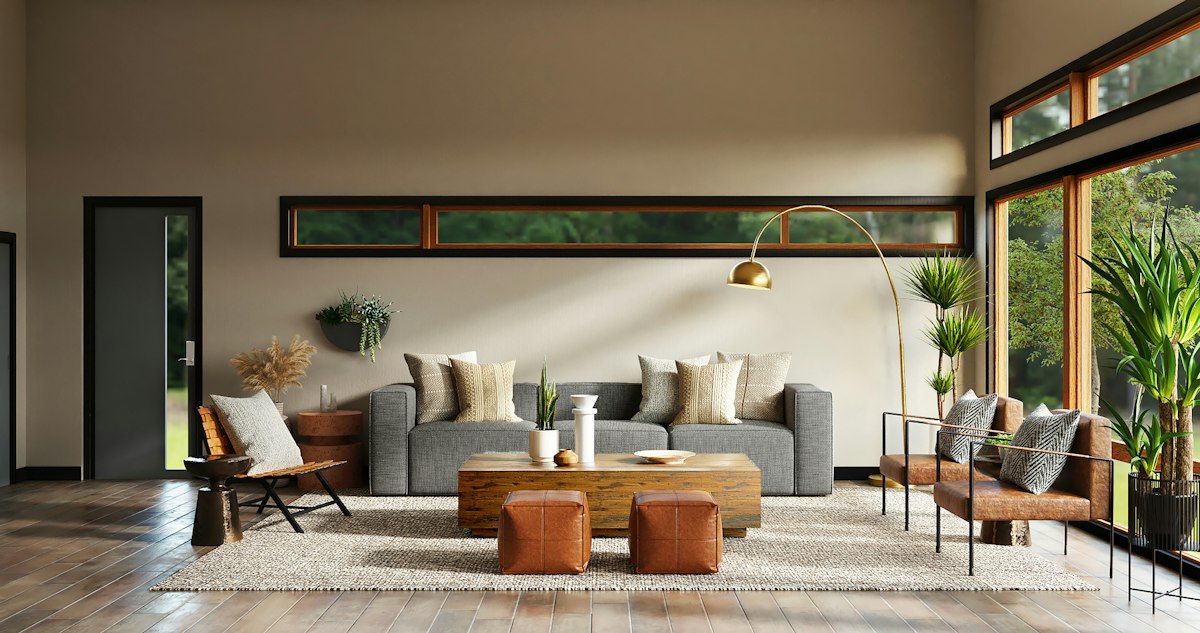
When we think about what makes a room feel premium, we reach for the obvious answers: expensive furniture, imported fabrics, designer lighting. But visit enough well-designed spaces and a pattern emerges: the rooms that feel truly special have something simpler in common. They are planned well. Space planning is the discipline that determines how furniture, movement, light, and activity are distributed across a room. It is the skeleton beneath the decoration, separating a room that merely contains furniture from one that genuinely functions as a space for human living.
The three principles that matter
Movement first. A room should allow its occupants to move through it comfortably without weaving between chairs. The primary pathway through any space should be clear. This sounds obvious but is routinely ignored. Most Indian homes have too much furniture pushed against walls, leaving an awkward void in the centre.
Zoning. Even a small room can hold several zones, say a reading nook, a place to talk and a desk, if each one is clearly defined. The tools are simple: a rug, a change in lighting, the angle of a chair. No walls required.
Balance, not symmetry. The goal is visual equilibrium, not mirror-image layouts. A heavy sofa can be balanced by a cluster of smaller furniture on the opposite side. An asymmetric arrangement often feels more alive than a perfectly symmetrical one.
For Indian homes specifically
Indian interiors often have to solve a unique challenge: multi-purpose spaces where one room serves simultaneously as living room, dining room, and home office. The answer is not to buy less furniture. It is to choose pieces that do multiple jobs and arrange them to create a sense of transition between functions. A well-placed bookshelf can divide a space without a wall. A dining table at the right height serves as a workspace during the day. Space planning turns constraints into design decisions.